
Responsible Travel

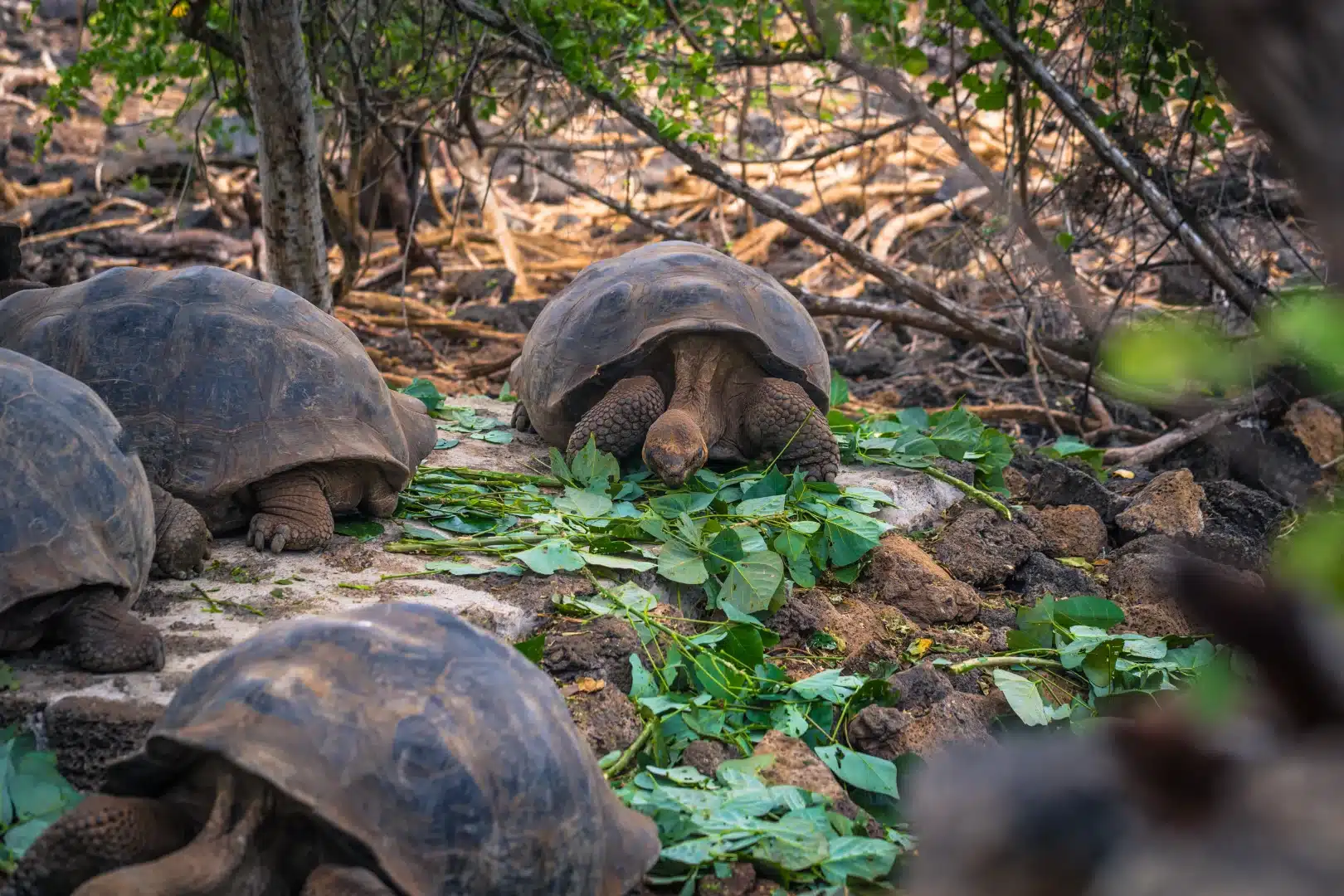
Galápagos tortoises: Slow guardians who defy time 🐢

06.01.2025

BY Elmer2

BlogGalapagos

Imagine a being that has seen more suns than any human. An animal that walked the Earth when empires had not yet risen. Galápagos tortoises are not only giants in size, but also in history of evolution and hope. Today, more than ever, they represent the perfect balance between science, myth and conservation.

With a calmly beating heart and a leisurely gait, these creatures can live for more than 100 years and weigh more than 250 kilos. They challenge us to rethink how we travel and care for our planet, they have transformed modern science and inspired legends. It goes far beyond their numbers.

THE ENIGMA OF THEIR ORIGIN: OPEN OCEAN TRAVELERS

Giant tortoises are not native to the Galapagos. Scientists believe that their ancestors arrived from South America floating on natural rafts of vegetation, carried along by ocean currents. Can you imagine a tortoise crossing the Pacific Ocean without a compass or a destination? That ancient voyage marked the beginning of one of the most amazing evolutionary stories on the planet.

Each island shaped its own turtles. Some turtles developed dome-shaped shells to move through the dense vegetation. Others, like those on Española Island, evolved to have saddle-shaped shells, perfect for craning their necks to reach tall cacti. This divergence provided Charles Darwin with fundamental clues to formulate his theory of evolution by natural selection.

THE SECRET OF LONGEVITY: SCIENCE THAT LOOKS TO THE FUTURE

While we look for ways to live longer, Galápagos tortoises have already mastered the art of longevity. Their extremely slow metabolism and resistance to oxidative stress have caught the attention of scientists at Yale, Harvard and even NASA. In 2022, a study revealed that their cells have unique mutations that repair DNA and prevent age-related diseases.

Studying their DNA could help develop treatments for cancer or degenerative diseases in humans, according to researchers. In this sense, they are not only guardians of their ecosystem, but also potential allies for the medicine of the future.

UNEXPECTED THREATS: TINY BUT LETHAL ENEMIES

However, their apparent strength hides a great fragility. For centuries, turtles were hunted by whalers and settlers. Today, they face new enemies: invasive species such as rats, wild cats and the dreaded Philornis downsi fly, whose larvae kill newborns by feeding on their tissue.

Climate change and uncontrolled tourism also pose challenges. For this reason, the work of institutions such as the Galapagos National Park and Galapagos Conservancy is essential. Their breeding, monitoring and education programs have succeeded in repopulating entire islands, and thanks to these efforts, the tortoise population has increased by 12% in the last five years.

RESPONSIBLE TOURISM: SEEING THEM WITHOUT DISTURBING THEM

Seeing a giant tortoise in its natural habitat is a transformative experience. But it is also a privilege that brings with it responsibility. For this reason, there are specific places where they can be observed without causing damage, such as the Charles Darwin Research Station on Santa Cruz or the regulated areas of Isabela Island.

Travelling with agencies committed to responsible tourism is key. They promote small groups, certified local guides and sustainable practices. In this way, you not only guarantee an authentic experience, but also contribute to protecting a fragile ecosystem.

You can also learn more in this article about what to see in the Galapagos and how to plan your ethical route.

BETWEEN MYTHS AND MEMORIES: THE ISLANDERS’ VISION

For the inhabitants of the Galapagos, turtles are symbols of wisdom, patience and connection with the earth. Turtles keep the secrets of time, and respecting them allows us to live in balance with nature, according to local legends.

The story of Fausto Llerena, the park ranger who took care of “Lonesome George”

Fausto Llerena dedicated decades to the conservation of giant tortoises in the Galapagos. He was the main caretaker of Lonesome George at the Charles Darwin Research Station, becoming a symbol of the fight for biodiversity.

Galápagos tortoises: Slow guardians who defy time

CONCLUSION: THE FUTURE MOVES SLOWLY, BUT SURELY

Galápagos tortoises have survived volcanic eruptions, pirates and centuries of exploitation. And yet their greatest challenge is only just beginning. They depend on human decisions, on our ability to act conscientiously, on our desire to preserve the unrepeatable.

When we see one of these creatures slowly raising its head towards the sun, we understand that true wisdom lies in patience, in adapting without destroying, in moving forward without crushing.

To travel to the Galapagos is to look at the past and the future at the same time. And the tortoises, those silent giants, are there to remind us of this.

🐢 WANT TO HELP?

Find out about active projects at Galapagos Conservancy, or check out our guides to conscious tourism in Ecuador to make your trip a positive experience for you and the planet.

THEY ALSO ASKED:

Where can I see Galapagos tortoises responsibly?

You can see Galapagos tortoises in authorized places such as the Charles Darwin Research Station or regulated areas of Isabela and Santa Cruz. Always travel with operators committed to responsible tourism.

Why do Galapagos tortoises live for so many years?

Their extremely slow metabolism and special DNA contribute to their longevity. Recent scientific studies even explore their resistance to cellular aging.

What is the most serious threat to Galapagos tortoises today?

Invasive species such as rats, feral cats and the Philornis downsi fly represent the greatest threats, especially to newborn hatchlings.

How did the giant tortoises arrive in the Galapagos?

It is believed that their ancestors crossed the ocean from South America on natural rafts, propelled by ocean currents, millions of years ago.